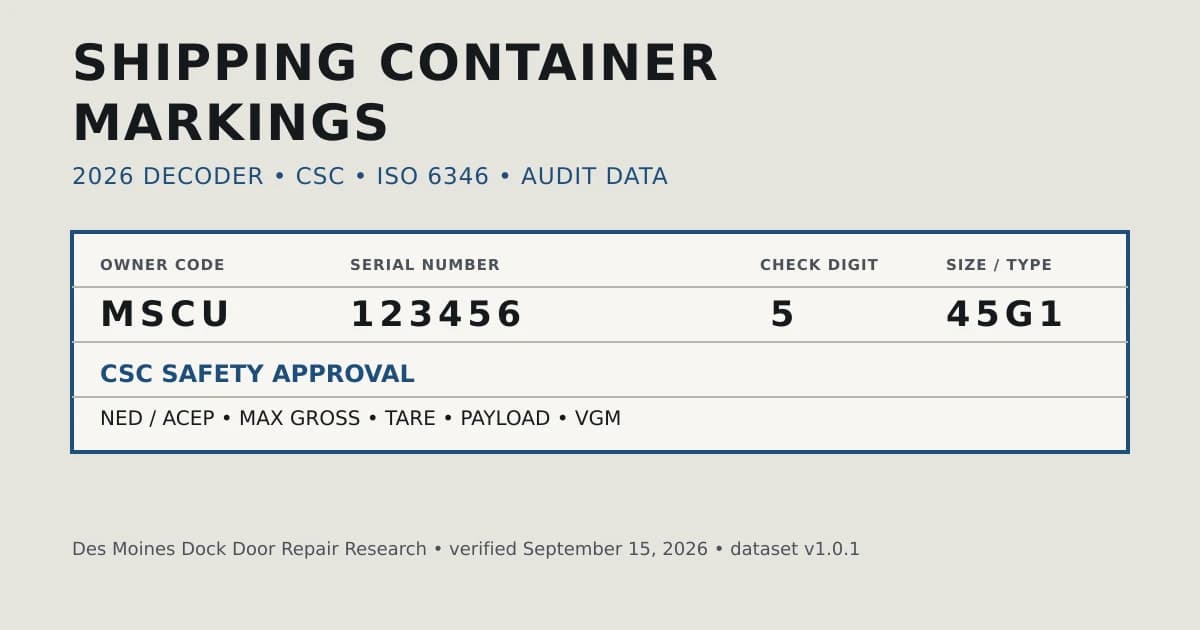
What are the key shipping container markings facts?
Shipping container markings include a check digit that is blind to 22 pairs of owner-code letters. Our September 15, 2026 computation shows that swapping either letter in one of those pairs leaves the checksum unchanged; that is a mathematical property, not a measured error rate. 8
- The container check digit cannot distinguish 22 pairs of owner-code letters. Substituting either member of one of those pairs at the same owner-code position always leaves the checksum unchanged. (Des Moines Dock Door Repair Research computation using the public calculation described by GDV, September 15, 2026; not a measured misread rate.) 8
- 44 of 650 directed letter substitutions at any one owner-code position — 6.77% — are always invisible to the check digit. Additional collisions occur because raw remainders 0 and 10 both print as 0; the 6.77% figure is not the total undetected-error rate, and serial-digit changes are not immune. (Des Moines Dock Door Repair Research computation, September 15, 2026.) 8
45G1is a 40-foot high-cube container, not a 45-foot container. Hapag-Lloyd publishes45G1for its 40-foot high cube and42G1for its 40-foot standard. (Hapag-Lloyd container specification pages, checked September 15, 2026.) 23 24
- The US next-examination marking must be capable of at least 24 months of legibility; the periodic examination interval can be as long as 30 months. Those are separate requirements, not permission to leave a required marking unreadable. (49 CFR 452.1(a)–(b), checked September 15, 2026.) 15
- 49 CFR 452.1(b) makes an owner punishable under 18 U.S.C. 1001 for affixing the next-examination marking without the required examination. The provision treats that marking as a misrepresentation within a US agency’s jurisdiction. (US Coast Guard regulation, checked September 15, 2026.) 15
- ISO listed the fifth edition of ISO 6346 as under publication from August 12, 2026; ISO 6346:2022 remained the published edition at this check. ISO’s “up to seven weeks” wording describes final production, not a guaranteed release date or seven weeks remaining from today. (ISO catalogue records 90821 and 83558, checked September 15, 2026.) 10 11
- ISO 6346:2022 does not cover the CSC safety approval plate. Its scope separates identification and operational marks from plates required by intergovernmental agreements, including the CSC and customs conventions. (ISO scope statement, checked September 15, 2026.) 10
- A CSC safety approval plate must be at least 200 mm × 100 mm, with its CSC SAFETY APPROVAL heading at least 8 mm high and other words and numbers at least 5 mm. (CSC plate requirements as published by BIC, checked September 15, 2026.) 5
- Under the US plate specification, the safety approval plate must remain legible after 15 minutes in a medium-intensity fire at 1,000 °F (540 °C), mounted on the specified container material. (49 CFR 451.23(b)(1), checked September 15, 2026.) 14
- BIC specifies identification characters at least 100 mm high and maximum-gross/tare characters at least 50 mm high. This does not establish a separate 100 mm minimum for the size/type code. (BIC identification and operational-mark references, checked September 15, 2026.) 1 2 3
- In four Hapag-Lloyd general-purpose examples, the 45-foot high cube has 159% more internal volume than the 20-foot standard but 430 kg less rated payload. The comparison is 86.0 versus 33.2 m³ and 27,700 versus 28,130 kg; it is not an industry average or a monotonic trend across every size. (Carrier pages checked and comparison recomputed September 15, 2026.) 22 23 24 25
- For a US-approved continuous examination programme, 49 CFR 452.7(b) specifies
ACEP/USA/followed by the year the programme was approved. The year is not the latest examination year, and the mark belongs as close as practicable to the safety approval plate. (US Coast Guard regulation, checked September 15, 2026.) 15
- An absent fumigation warning does not establish the absence of fumigant. The 2014 CTU Code also warns that previously ventilated units can contain gas released by cargo that absorbed it. (IMO/ILO/UNECE CTU Code, annex 5, §4.1.2.3, checked September 15, 2026.) 27
- 1,597,818,177 of 17,576,000,000 hypothetical freight-container identifier bodies — 9.0909% — produce raw remainder 10, which prints as check digit 0. This counts all 26³ owner prefixes with equipment letter U and six-digit serials; it does not count registered containers or numbers that “cannot be issued.” (Des Moines Dock Door Repair Research exact computation, September 15, 2026.) 8
- 36,000 kg is approximately 79,366 lb, leaving only 634 lb in an illustrative 80,000 lb whole-vehicle comparison. The 36,000 kg reference comes from ISO 668:2020’s base text; Iowa has higher qualifying noninterstate limits and permit exceptions, so 80,000 lb is not a universal statewide ceiling. (ISO base-text preview, NIST conversion, Iowa Code 2026 and original subtraction; checked September 15, 2026.) 13 20 21 28
Shipping container markings are not decoration, and they do not all come from the same rule book. Read the owner prefix in BIC’s theoretical BICU 123456 5 example as LIC or VIC and the check digit remains 5; those constructed substitutions say nothing about registration or a physical unit. The blind spots are not confined to owner letters: the final conversion of remainder 10 to 0 also permits some serial-digit errors to pass. 8 9
Below are the main identification, operational and approval markings, what each means, what it cannot prove, which instrument governs it, and the minimum dimensions we could verify. The scope is a source-checked reference and a reproducible computation—not a complete inspection manual.
Byline: Des Moines Dock Door Repair Research
Last verified: September 15, 2026.
Contents: The check digit’s blind spots · Every marking in the register · What this shows and what it doesn’t · How we built this · Who requires each marking · Reading a container number · What 45G1 means · Max gross, tare, payload and VGM · What a CSC plate proves · NED and ACEP · Minimum sizes in millimetres · Hazard and fumigation marks · Can you load to the number on the door? · Why this is changing now · Limitations · How to cite · Download the data · FAQ · Sources
Why can’t the container check digit catch every error?
The eleventh character of a container number is a check digit: a calculated figure intended to reveal keying and reading errors in the other ten. It is not uniformly reliable: 44 of the 650 directed single-letter substitutions at a fixed owner-code position always preserve it, and additional errors can survive when raw remainders 0 and 10 collapse to the same printed 0. The analysis below separates those two mechanisms instead of claiming that every serial-digit error is caught. 8
How the check digit works
Each letter carries an assigned number. A is 10, and the count skips every multiple of 11 on the way up, so B is 12, K is 21, L is 23, U is 32 and Z is 38. Digits keep their own value. Each of the first ten characters is multiplied by its position weight—1, 2, 4, 8, 16, 32, 64, 128, 256, 512, left to right—and the products are added. Divide that total by 11: remainders 0 through 9 print as themselves, while remainder 10 prints as 0. 8
BIC publishes the theoretical example BICU 123456 5. Our implementation returns 5 for it, 9 for GDV’s published SUDU3070079 example and 6 for its TEXU4521496 example. All three match. The separately constructed examples below are labelled as calculations, not container records. 8 9
Table 1. Worked check-digit calculation on BIC’s published example
| Position | Character | Assigned value | Weight | Product |
|---|---|---|---|---|
| 1 | B | 12 | 1 | 12 |
| 2 | I | 19 | 2 | 38 |
| 3 | C | 13 | 4 | 52 |
| 4 | U | 32 | 8 | 256 |
| 5 | 1 | 1 | 16 | 16 |
| 6 | 2 | 2 | 32 | 64 |
| 7 | 3 | 3 | 64 | 192 |
| 8 | 4 | 4 | 128 | 512 |
| 9 | 5 | 5 | 256 | 1,280 |
| 10 | 6 | 6 | 512 | 3,072 |
| Total | 5,494 | |||
| 5,494 ÷ 11 = 499 remainder | 5 |
Source: BIC theoretical example; GDV public algorithm explanation; calculation recomputed by Des Moines Dock Door Repair Research, September 15, 2026. 8 9
The 22 letter pairs the check digit cannot see
Dividing by 11 means any two letters whose assigned values differ by 11 or 22 behave identically inside the sum. Swap one for the other at the same owner-code position and the arithmetic lands in exactly the same place. The 26 letters therefore collapse into ten behaviour groups.
Table 2. The ten check-digit behaviour groups
Source: Letter values generated from the public algorithm described by GDV; grouping computed by Des Moines Dock Door Repair Research, September 15, 2026. 8
Twenty-two unordered pairs in total: six groups with three pairs each, plus four groups with one pair each. Counting the two directions separately gives 44 substitutions out of 26 × 25 = 650 possibilities at each owner-letter position. No assigned letter value is divisible by 11.
The practical version is a constructed variation on BIC’s own example: BICU1234565, LICU1234565 and VICU1234565 all pass the arithmetic check. This does not say that those prefixes are registered, unregistered or owned by the same organisation. Registration is a separate lookup, and changing the equipment letter to K or A would fail the U/J/Z format rule even if a permissive calculator returned the same digit. 1 8 9
Where the scheme is strong—and where zero creates another blind spot
The raw remainder distinguishes every pair of different decimal digits. The final printed digit does not always do so, because two raw remainders share 0. The table counts a directed change once as a pattern, then distinguishes changes that are always invisible from changes that can be invisible only at the zero boundary.
Table 3. Error-pattern audit using the complete printed-check-digit rule
Source: Exact computation by Des Moines Dock Door Repair Research, September 15, 2026. Each pattern was also tested against all 11 possible starting raw remainders. These counts describe patterns, not observed mistakes or a fleet-weighted detection rate; the reproducible script and state-grid results are in the dataset. Algorithm reference: 8
The owner-position rows overlap: the combined row is the sum of the three positions, not an additional population. The same applies to the all-body row. A swap across positions 4–5 moves a letter into the serial field and a digit into the equipment field, so it is structurally invalid and excluded from the 456 format-valid non-owner transposition patterns. For positions 3–4, only swaps using U, J and Z in both positions keep the equipment field valid. The download records each adjacent pair separately.
Here is the shortest counterexample to “all serial-digit errors are caught”: BICU0000140 and BICU2000140 both have printed check digit 0. Their raw remainders are 0 and 10 respectively. Only the first serial digit changed. These are synthetic examples generated for the audit, not assertions about real containers.
U (32), J (20) and Z (38) have different raw remainders, so the raw calculation separates them. The same zero boundary can nevertheless hide some equipment-category substitutions in the printed digit. Changing only the final check digit, with the first ten characters unchanged, fails an equality check; that different test is not part of the 2,496 body-change patterns.
What happens to numbers whose remainder is 10?
For every possible three-letter owner prefix with equipment category U, either 90,909 or 90,910 of its 1,000,000 serials produce raw remainder 10. Of the 17,576 possible prefixes, 15,983 have 90,909 such serials and 1,593 have 90,910. Across that hypothetical space, 1,597,818,177 of 17,576,000,000 bodies—9.0909%—produce remainder 10.
Those numbers are not mathematically unissuable. The public algorithm prints 0 for them. GDV describes avoiding remainder-10 serials as a recommendation, not a rule that the calculation has no digit to print. Our count includes every possible prefix, not just prefixes registered with BIC, and makes no estimate of how often this occurs in the operating fleet. 8
None of this means anybody is doing anything wrong. A check digit checks internal transcription consistency; it is not a fraud control, proof of title or inspection. The audit describes the calculation’s behaviour and makes no claim about the condition of any container in service. 1 9
Audit files: check-digit-audit.csv contains the 26 letter values and groups; blind-spot-pairs.csv contains the 22 unordered pairs; single-character-audit.csv and transposition-audit.csv contain the position-by-position tests; validation.csv identifies published versus constructed examples. check-digit-audit.py reproduces the figures from reference-inputs.json, including the remainder-10 count.
What does each marking on a shipping container mean?
The register contains 23 selected marking records, including individual identifier components and conditional markings—not a claim that every container carries 23 separate labels. Each record states what the mark establishes, what it does not establish and whether the named source is a governing rule or an explanatory reference. A symbol or number can be real without establishing the conclusion someone is trying to draw from it.
Table 4. The container marking register: meaning, authority and limits
| Marking | What it means | What it does not establish | Governing instrument or reference; applicability | Tier |
|---|---|---|---|---|
| Owner code (first three letters) | The registered owner or principal operator | Cargo origin, contents or who holds title to this unit today | ISO identification system; BIC registration; BIC Codes / identification reference. Required within this identification system 1 9 | ★ |
| Equipment category identifier U | A freight container | Whether it is dry, reefer or open-top | ISO identification system, explained by BIC; Equipment category U. Required category within this format 1 9 | ★ |
| Equipment category identifier J | Detachable freight-container-related equipment | A trailer or chassis; that category is Z | ISO identification system, explained by BIC; Equipment category J. Conditional equipment category 1 9 | ★ |
| Equipment category identifier Z | A trailer or chassis | A freight container | ISO identification system, explained by BIC; Equipment category Z. Conditional equipment category 1 9 | ★ |
| Six-digit serial number | The owner/operator reference for the unit | A standardised manufacture date or other guaranteed encoded meaning | ISO identification system, explained by BIC; Serial number. Required within this format 1 9 | ★ |
| Check digit | A checksum for recording/transmission consistency | Registration, ownership, existence, condition or proof of error-free transcription | ISO identification system; GDV algorithm explanation; Check digit / handbook section 3.3. Required within this format 1 8 9 | ★ |
| Size and type code | Length, width/height, and detailed type/characteristics | Actual cargo mass or usable door opening | ISO size/type system, explained by BIC; Size & Type Code. Code interpretation 3 | ★ |
| Letter in fourth position of detailed size/type code | Reduced stacking and/or racking capability under the relevant table category | The exact load limit or present condition | BIC published detailed type-code table; Reduced-capability column and footnote. Conditional detailed type code 4 | ★ |
| MAX GROSS | Maximum permitted combined container-and-contents mass at the stated rating | Actual packed mass or legal vehicle-combination weight | Operational marks explained by BIC; CSC rating; Mandatory Operational Marks. Operational marking 2 14 | ★ |
| TARE | Mass of the empty container | Cargo mass or a universal tare for every unit of the same type | Operational marks explained by BIC; Mandatory Operational Marks. Operational marking 2 | ★ |
| NET / PAYLOAD | Rated available mass: maximum gross minus tare | Permission for a road movement or any load arrangement | Additional owner marking described by BIC; Mandatory Operational Marks discussion of payload. Optional additional marking; not universal 2 | ★ |
| CU. CAP. / capacity | Internal volume | A weight limit or a guarantee that a shape fits through the door | Informational capacity marking illustrated by BIC; Marking of Containers. Informational; not established here as universally mandatory 6 | ★ |
| Height mark for containers over 2.6 m | Container height in metres and in feet/inches | Vehicle height, route clearance or door-opening clearance | Operational marks explained by BIC; Height marking. Conditional height warning 2 | ★ |
| Overhead electrical danger sign | Warning of overhead electrical danger | That the container is energised or climbing is otherwise safe | Operational marks explained by BIC; Overhead Electrical Danger Warning. Conditional on ladder-equipped container 2 | ★ |
| CSC safety approval plate | Approval under the applicable CSC framework | Present condition, current examination or building/land-use approval | CSC; US 49 CFR part 451 subpart C; 451.21, 451.23. Applicable approved containers 5 14 30 | ★ |
| Manufacture month and year | When the container was manufactured | When it was last examined | CSC plate requirements, explained by BIC; CSC Combined Data Plate. Approval plate field 5 | ★ |
| US safety approval number | Approving country, authority/reference and year of approval | A recent individual examination | US Coast Guard regulation; 49 CFR 451.25(a). US approval format 14 | ★ |
| Next examination date (NED) | Month and year before which next examination is due | That an examination occurred or the container is fit today | US Coast Guard regulation; 49 CFR 452.1(b). Periodic examination marking 15 | ★ |
| ACEP marking | Participation in an approved continuous examination programme | Exemption from thorough examination or maintenance | US Coast Guard regulation; 49 CFR 452.7(b), 452.9. Approved programme; national scheme format applies 15 | ★ |
| Customs approval plate | Approval for transport under customs seal | Structural safety approval | Applicable customs convention and US customs certification; 19 CFR 115.30, 115.32, 115.40, 115.42. Customs-approved containers under applicable procedure 29 | ★ |
| Timber treatment plate | Treatment information concerning the wooden floor | Treatment of the cargo or current freedom from pests | BIC descriptive reference; not a universal legal requirement; CSC Combined Data Plate. Where present; current national treatment acceptance not assessed 5 | ★ |
| Hazard placards | Cargo hazard class/division when placarding requirements apply | Container identity/type or a complete account of every possible hazard | PHMSA hazardous materials regulations; 49 CFR 172.504, 172.512, 172.519. Cargo-, quantity-, mode- and exception-dependent 19 33 16 | ★ |
| FUMIGANT marking | Lading has been or is being fumigated | That an unmarked or previously ventilated unit is free of fumigant | PHMSA regulation; CTU Code safety guidance; 49 CFR 173.9; CTU Code annex 5, 4.1.2.2–4.1.2.4. Fumigated lading; applicable rules and exceptions 18 27 | ★ |
Source: BIC public references; US Coast Guard and PHMSA regulations; US customs certification rules; IMO and the IMO/ILO/UNECE CTU Code. Individual links appear in the table and exact URLs/check dates appear in the CSV. All entries checked September 15, 2026.
Verification key: ★ means the stated claim was checked directly against the named source. A BIC reference is identified as BIC guidance, not misrepresented as a direct read of the licensed ISO standard. ● would identify a cited primary excerpt whose full context was not retrieved; no row in this version relies on that lower tier. The timber row is descriptive, not a claim that a current Australian rule universally requires that plate.
Download the 23-record marking register (CSV). Fields include the stable mark ID, location, meaning, inference limits, governing instrument or reference, section, applicability, format, verification basis, source URLs and verification date. The JSON bundle includes the same records without flattening their provenance.
What does this data show, and what doesn’t it show?
This page is a compilation and a mathematical audit, not a survey. It explains selected markings and their documented requirements, and it calculates properties of a published check-digit procedure. It does not establish the condition of any particular container or count anything in the field.
Three things it is not. It is not an inspection standard—nothing here substitutes for a qualified examiner. It is not a reproduction of ISO 6346 or ISO 668; the full normative code tables stay with their publishers. And it is not a measurement of how often markings are wrong, missing or misread: no field-error dataset was used. Where a number is our own arithmetic rather than a source’s published fact, the line says so. 10 12 15
“Undetected pattern” and “observed misread” are different units. Likewise, a carrier’s example specification and an industry average are different evidence. The tables keep those denominators and boundaries visible instead of turning a precise calculation into an unsupported prevalence claim.
How was this reference built and checked?
The source review and calculations in this version were completed on September 15, 2026. Four kinds of work went into it: direct rule checks, public marking references, carrier examples and reproducible computation. Source publication dates are retained separately from that verification date.
Primary instruments, read directly. We read the relevant US Coast Guard plate and examination provisions in 49 CFR part 451 subpart C and part 452, the PHMSA placarding and fumigation provisions, and US customs container-certification rules. We checked Iowa Code §321.463 against the Legislature’s 2026 PDF, including the weight and fine tables, and checked the permit exceptions against Iowa DOT and the cited statutes. The ISO edition/status claims come from ISO’s own catalogue records. The CTU warning comes from the original code PDF supplied by the International Labour Organization. 14 15 16 18 19 20 21 27 29 31 32 33
The marking specifications. At this check ISO listed ISO 6346:2022 at CHF 135 and ISO 668:2020 at CHF 100. We did not purchase the complete standards. Marking sizes, placements and public code explanations are attributed to BIC, whose owner-code register was adopted into the ISO system in 1972—not presented as a direct read of the normative text. The accessible original ISO 668:2020 preview supports the explicitly labelled base-text 36,000 kg comparison. The later amendment was not read. 2 3 4 5 9 10 12 13
Carrier-published examples. We checked four Hapag-Lloyd pages: 20-foot standard, 40-foot standard, 40-foot high cube and 45-foot high cube. Each record retains the published size/type code, capacity, maximum gross mass, tare and maximum payload. Hapag-Lloyd states that these specifications are examples from its own fleet and can vary by manufacturer, so they are attributed examples, never industry norms. The incompatible kilogram/pound tare figures on the 45-foot page are retained and flagged; metric values drive the payload comparison. 22 23 24 25
Original computation. The audit implements the public ISO-format calculation described in GDV’s Container Handbook, including its explicit remainder-10-to-0 rule. GDV’s explanatory prose contains a “third by 3” inconsistency beside its stated powers-of-two formula; the implementation uses that formula, whose third weight is 4, and matches BIC’s example plus GDV’s two published examples. This is a transparent reconstruction of that public algorithm, not a claim that we reviewed the complete 2022 or forthcoming fifth-edition annex. 8 9
We tested all 2,496 directed substitutions in body positions 1–10 and the format-valid adjacent transpositions. For each pattern we also tested all 11 possible starting raw remainders. That state grid checks the arithmetic completely for the defined pattern; giving each state equal weight does not make its percentage a measured, fleet-weighted or camera-error rate.
For the full freight-container identifier space, we counted the 11 possible residues of every six-digit serial and every three-letter prefix with equipment category U, then joined those integer counts. This exact calculation accounts for all 17,576,000,000 hypothetical bodies without sampling or pretending to loop over 17.576 billion records. A separate direct enumeration of all 1,000,000 serials reproduced the same residue counts. Published validation examples, constructed counterexamples, intermediate tables and executable code ship together.
The other calculations are subtraction, ratios and unit conversion. Volume growth uses the 20-foot example as its denominator; the payload-range percentage uses the minimum payload among the four examples. Converted pounds use NIST’s exact 0.45359237 kg per avoirdupois pound and are rounded only where labelled. Iowa fine examples apply the statutory one-half factor to the stated schedule; they do not predict a total court assessment. 20 22 23 24 25 28
Two dates are kept apart throughout. Source vintage is when a document or edition was issued; an undated live page is identified as such. Check date is when it was reviewed. Neither is silently turned into the publication date of this page, and a retrieved regulation is not labelled unchanged merely because a website’s comparison timeline begins in a particular year.
Who actually requires each marking?
Different rule systems write on the same container door. ISO 6346:2022 explicitly separates its own mandatory and optional provisions from regulatory requirements, and excludes plates imposed by intergovernmental agreements or national legislation. A label’s appearance does not tell you which legal instrument, contract or standard applies to the movement. 10
ISO’s scope note names the CSC, the Customs Conventions on Containers of 1956 and 1972 and the Convention on Temporary Admission agreed at Istanbul on 26 June 1990. The safety approval plate therefore sits outside ISO 6346’s marking requirements, even though both may be read on the same door. 10
Table 5. Four rule systems that can appear on the same container
| Instrument or system | What it governs | United States applicability |
|---|---|---|
| ISO 6346:2022 | Identification, size/type and operational marks; physical presentation | ISO’s mandatory/optional terminology describes its own marking provisions, not requirements imposed by a regulator. 10 |
| International Convention for Safe Containers, 1972, as amended | Container safety approval and the safety approval plate | US implementing provisions include 49 CFR parts 451 and 452, whose authority cites 46 U.S.C. 80503. 14 15 30 |
| Applicable customs conventions and national certification rules | Approval for transport under customs seal; temporary-admission rules are a separate question | US approval-plate procedures are in 19 CFR part 115, including the 1972 Container Convention and 1975 TIR Convention references. ISO also names the 1956 and 1972 Container Conventions and the 1990 Istanbul Convention as outside its scope; that list is not a claim that every instrument applies to every US movement. 10 29 |
| PHMSA hazardous materials regulations | Cargo hazard marks, labels and placards, subject to applicability and exceptions | 49 CFR part 172 separates marking (subpart D), labelling (subpart E) and placarding (subpart F); fumigated lading is addressed in 173.9. 18 19 33 34 |
Source: ISO 6346:2022 scope statement; US Coast Guard, customs and PHMSA provisions; IMO CSC guidance. Checked September 15, 2026.
For a writer, the practical consequence is short: “ISO requires it” and “the law requires it” are different sentences. A precise caption names the standard or regulation and keeps its jurisdiction and applicability attached. An optional mark is not automatically false or noncompliant; ISO states that its relevant presentation provisions apply when an optional mark is displayed. 10
How do you read a container number?
A container identification number has eleven characters: three owner letters, one equipment-category letter, six serial digits and one check digit. BIC specifies identification characters at least 100 mm high, proportionate, durable and contrasting with the container. Those characters identify and check a number; they do not certify the condition of the equipment. 1 9
Using BIC’s own theoretical example, BICU 123456 5 breaks apart like this:
- BIC — the owner prefix: three capital letters in the BIC registration system.
- U — the equipment category: U for freight containers, J for detachable freight-container-related equipment, and Z for trailers and chassis.
- 123456 — the six-digit serial chosen by the owner/operator. Leading zeros are part of the number and must be kept.
- 5 — the check digit calculated from the ten preceding characters. 1 8 9
Why four letters and seven digits total eleven characters
“Four letters and seven digits” is a correct shorthand: the seven digits include the six serial digits and the check digit. It does not mean a seven-character identifier, or seven extra digits after the check digit. Spaces in a painted or typeset example separate components visually; they are not additional identifier characters. 1 9
What a valid check digit does not prove
A correct check digit means the characters pass the arithmetic consistency check. It does not mean the prefix is registered, the container exists, the owner is who the paperwork says, or the box is safe to load. The audit above shows why it does not even rule out a single misread. Owner prefixes have a registry; condition has an examination process. A formula cannot replace either. 1 9 15
What does 45G1 mean, and why isn’t it a 45-foot container?
45G1 is a 40-foot high-cube container, not a 45-foot container, in the Hapag-Lloyd example below. Each character is decoded separately: the first gives length, the second width/height characteristics, and the final two give type and characteristics. The size/type code is a separate four-character mark, not part of the eleven-character container identifier. 3 24
Read as a block, 45 looks like “45 feet”. Read character by character here, 4 is 40 feet and 5 identifies the 9 ft 6 in high-cube height. The same distinction matters for 42G1: 4 is 40 feet and 2 identifies the 8 ft 6 in standard height for this example. Those are external/nominal equipment descriptions, not usable interior or door-opening dimensions. 3 23 24
Table 6. Published carrier examples, read character by character
| Code | First character: nominal length | Second character: height for these examples | Detailed type | Capacity | Max gross, as published | Tare, as published | Max payload, as published |
|---|---|---|---|---|---|---|---|
22G1 22 | 2 = 20 ft | 2 = 8 ft 6 in | G1 general purpose | 33.2 m³ | 30,480 kg / 67,197 lb | 2,350 kg / 5,181 lb | 28,130 kg / 62,016 lb |
42G1 23 | 4 = 40 ft | 2 = 8 ft 6 in | G1 general purpose | 67.7 m³ | 32,500 kg / 71,650 lb | 3,750 kg / 8,267 lb | 28,750 kg / 63,383 lb |
45G1 24 | 4 = 40 ft | 5 = 9 ft 6 in | G1 general purpose | 76.3 m³ | 32,500 kg / 71,650 lb | 3,900 kg / 8,598 lb | 28,600 kg / 63,052 lb |
L5G1 25 | L = 45 ft in carrier example | 5 = 9 ft 6 in | G1 general purpose | 86.0 m³ | 32,500 kg / 71,650 lb | 4,800 kg / 10,552 lb (published unit conflict) | 27,700 kg / 61,067 lb |
Source: Hapag-Lloyd’s four linked specification pages, checked September 15, 2026; public code interpretation from BIC. These are fleet examples, not industry averages. Published imperial figures are retained, not silently recomputed. 3 4 22 23 24 25
The comparison across these four examples. Volume climbs from 33.2 to 86.0 cubic metres—a 159.04% increase, or 2.59 times the volume. Rated payload moves from 28,130 kg to 27,700 kg. The largest box in the set has 430 kg less rated payload than the smallest. Across all four examples, payload ranges from 27,700 to 28,750 kg, a spread of 1,050 kg or 3.79% of the minimum payload. This is an endpoint comparison and range, not a claim that payload falls at every step up in size. 22 23 24 25
Tare rises from 2,350 kg to 4,800 kg across the endpoints, but their maximum gross ratings differ too. At a fixed gross rating, every additional kilogram of tare removes one kilogram of rated payload. The 40-foot standard and high-cube examples make that exact comparison: both have a 32,500 kg maximum gross rating; the high cube has 150 kg more tare and 150 kg less payload. More space does not automatically mean more permitted cargo mass. (Comparisons recomputed September 15, 2026.) 23 24
A second source conflict: the 45-foot tare units. Hapag-Lloyd prints 4,800 kg and 10,552 lb for the same tare entry. Those values are not equivalent: using NIST’s exact conversion, 4,800 kg is approximately 10,582 lb, rounded to the nearest pound. We retain both published cells in the table and download, flag the conflict, and calculate the comparison from kilograms; we do not silently replace the carrier’s stated pounds or declare which field it intended. 25 28
An unresolved conflict on the 45-foot length code
Here the public record does not agree with itself, and we are not going to smooth it over.
BIC’s published length table, read on September 15, 2026, lists code 5 against 13,716 mm (45 ft) and shows code L without an assigned length. Hapag-Lloyd publishes L5G1 as the ISO size type of its 45-foot high cube and L5GP as its type group. Both statements describe the sources as displayed, not a resolved normative mapping. 3 25
We did not obtain the complete licensed ISO 6346:2022 table, so we do not attribute a cause to that discrepancy. The carrier code stays an attributed example. A full normative ruling belongs to the applicable standard and its issuing body, not to a guess about a blank cell. 10
The letter that means reduced strength
A letter in the fourth position of the detailed size/type code has a specific role in BIC’s table. Its detailed-code columns distinguish full stacking/racking capability from reduced stacking and/or racking capability, with alphabetic endings in the reduced-capability column. Do not apply that rule to a type-group code such as L5GP: type groups and detailed type codes are different levels of description. 3 4 25
Whether a container was designed and tested at full or reduced capability is a design fact, not a present-condition finding from the paint. The code alone does not supply every applicable load limit. BIC’s table and the underlying standard provide the mapping; the unit’s approved data and condition remain separate checks. 4 5 15
Download the four carrier examples (CSV), including both raw tare-unit entries and their conflict note. The quoted calculations use the same metric fields in the JSON bundle.
What is the difference between max gross, tare, payload and VGM?
MAX GROSS is a rating, TARE is the empty-container mass, and PAYLOAD is maximum gross minus tare. VGM is the actual mass of the container as packed for a particular shipment, verified using an accepted SOLAS method. Tare is not a rating, and VGM need not come from weighing the complete packed unit in one operation. 2 26
Table 7. The four weight figures, and what each one is
| Figure | What it is | Measured, verified or rated? | Where it comes from |
|---|---|---|---|
| MAX GROSS | Maximum permitted combined container-and-contents mass | Rated maximum | Marked on the container; BIC says it must match the CSC plate figure. 2 |
| TARE | Mass of the empty container | Empty-equipment mass, not a cargo-capacity rating or the shipment’s packed mass | Marked on the container; technical records may also be available in BoxTech. 2 7 |
| NET / PAYLOAD / MAX PAYLOAD | Maximum gross minus tare | Derived rated capacity | Displayed by some owners as an additional marking, not a universal separate stencil. 2 |
| VGM: verified gross mass | Actual combined mass of the container as packed for the shipment | Verified by an accepted weighing or certified summation method | Shipper’s declaration under applicable SOLAS regulation VI/2 requirements. 26 |
Source: BIC operational-mark and BoxTech references; IMO packed-container gross-mass verification guidance. Checked September 15, 2026. 2 7 26
The public plate description contains a terminology conflict. BIC’s combined-plate prose calls the capacity field payload or maximum net mass, but BIC’s operational-mark reference says the maximum gross must match the CSC plate. The CTU Code independently identifies that plate field as maximum gross mass in §6.2.2 and annex 4, §§1.2 and 2.1–2.2. This reference uses maximum gross for the plate field and retains the conflicting BIC wording here rather than treating gross and payload as synonyms. 2 5 27
The rated-payload subtraction does not reserve the whole difference for saleable cargo. The CTU Code’s annex 4, §2.4 also accounts for additional attached items and securing/bracing materials when determining the mass available for cargo. Those items are not extra weight allowed above the container’s rating. 27
The Hapag-Lloyd 40-foot high-cube example makes the arithmetic visible: 32,500 kg maximum gross − 3,900 kg tare = 28,600 kg rated payload. That is one published equipment example, not an industry average and not a road allowance. Its empty mass is an input; the resulting payload is a capacity, not a measurement of cargo actually loaded. 24
The SOLAS changes were adopted through resolution MSC.380(94) during IMO’s Maritime Safety Committee meeting in November 2014, accepted on January 1, 2016 and effective from July 1, 2016. For covered shipments, the shipper provides the verified gross mass in the shipping document in time for the vessel’s stowage planning; a packed container cannot be loaded without the required VGM. That requirement does not turn the MAX GROSS stencil into a shipment measurement. 26
IMO permits two methods: weighing the packed container, or weighing its packages and cargo items—including pallets, dunnage and securing material—and adding the container tare using a certified method approved by the competent authority where packing was completed. An unsupported estimate is not a substitute. This is a distinction between verification methods, not instructions for conducting a hazardous loading operation. 26
So the tare stencil on the door is not trivia. Under the second method it is an input to the verified total. BIC’s free, non-profit BoxTech database provides technical records including tare, maximum gross mass and maximum payload; its own page reported over 15 million container records at the September 15, 2026 check. That database description is not a promise that any particular unit has a complete or current record. 7 26
What does a CSC safety approval plate prove?
The CSC plate is a container’s safety-approval record under the applicable International Convention for Safe Containers framework. It does not establish that the individual container is in good order today, and the owner’s maintenance and examination duties remain separate. Approval by a tested design type is one approval route; the mere presence of a plate is not a current inspection result. 14 15 30
BIC describes the plate as usually located on the outside of the left-hand door. The physical requirements it publishes are specific: a permanent, non-corrosive, fireproof rectangular plate not less than 200 mm × 100 mm; a CSC SAFETY APPROVAL heading at least 8 mm high; and other words and numbers at least 5 mm high. These are the BIC-published plate requirements, not a claim that we purchased and checked every clause of the convention’s consolidated text. 5
In the United States, 49 CFR 451.23(b) adds performance requirements. Mounted on material specified for the container, the plate must remain legible after 15 minutes in a medium-intensity fire at 1,000 °F (540 °C), resist the specified marine and industrial corrosion exposures for the working life of the container, and retain legibility for that service life. Those test conditions are not a promise that a container surviving a fire is fit for use. 14
Under 49 CFR 451.25(a), line 1 uses the US country designation, approval number including the approval-authority identification code, and year of approval. Line 3 carries the manufacturer’s identification number; §451.25(d) allows the owner’s ISO identification number in its place, subject to the required records. If ownership and that number change, the regulation provides for adding the new number after the original one, or a replacement plate where it cannot fit legibly, with the original information retained on file. This is an explanation of the record fields, not authority to alter an approval plate without complying with the rule. 14
In practice the CSC panel may form part of a combined data plate. Other panels can record customs approval for transport under seal, treatment of a wooden floor, or optional owner information. Their proximity does not merge their purposes: a customs approval is not structural safety approval, and a floor-treatment record does not describe the cargo’s current pest status. 5 29
What do NED and ACEP markings mean?
For containers covered by the US periodic scheme, the first examination is due no later than five years after manufacture, and subsequent examinations at intervals no longer than 30 months, with the next due month and year marked on or near the safety plate. A US-approved continuous programme instead uses ACEP/USA/ followed by the year that programme was approved. Neither marking, by itself, establishes present fitness. 15
It means a system is supposed to be looking at the container. Whether the examination was properly done, its findings acted on and its record retained are different questions. 15
Three details from the US regulations matter when interpreting those markings:
The marking-durability number and the examination interval are different. Section 452.1(b) permits a decal, sticker, stencil or other marking capable of remaining legible for at least 24 months. Section 452.1(a) permits an examination interval of up to 30 months. The six-month numerical difference is real; it is not a legal conclusion that an unreadable required date remains compliant until the examination falls due. The rule still requires the next-examination marking. 15
The sticker represents a regulated examination. The same paragraph says that affixing the next-examination marking without an examination meeting §452.3 is a misrepresentation in a matter within a US agency’s jurisdiction, making the owner punishable under 18 U.S.C. 1001. This is the wording of the regulatory provision, not a finding that a particular owner committed an offence. 15
A continuous programme is not an exemption. Section 452.9(a)(1) requires a thorough examination at each major repair, refurbishment or on-hire/off-hire interchange, and allows no more than 30 months between thorough examinations. Safety-related deficiencies found must be corrected before continued service, and the examinations are performed by qualified personnel. A programme name cannot override a defect. 15
The regulations retain January 1, 1987 compliance dates for the next-examination and ACEP markings. Those dates explain historical implementation; they do not turn a 2026 verification into evidence that the text has never changed since a website’s timeline began. The current provisions—not a supposed age-based exemption—are the sources for this reference. 15
How big does each marking have to be?
Many container markings have specified minimum dimensions or placement requirements; the table collects 15 specification entries, including one explicit limit on what the reviewed evidence establishes. Identification characters, mass marks, CSC text and hazard placards are not governed by one universal character-size rule. Each dimension below stays attached to its source and applicability. 1 2 5 14 15 16
Table 8. Minimum sizes, placements, performance requirements and one verification boundary
| Marking | Requirement or verified boundary | Instrument or reference |
|---|---|---|
| Identification number characters | Minimum character height: 100 mm; 4 in (BIC wording). Proportionate, durable, contrasting colour | BIC identification reference 1 |
| Size/type code characters | Verification boundary: No separate minimum established in reviewed BIC reference. The 100 mm sentence on that page expressly describes the identification sequence; it is not evidence for a separate code-height claim | BIC Size & Type Code 3 |
| Maximum gross and tare characters | Minimum character height: 50 mm. Applies to mass characters described by BIC | BIC operational marks 2 |
| Lightning symbol | Minimum symbol height: 175 mm; 6.875 in (BIC wording). Black on yellow; ladder-equipped container | BIC operational marks 2 |
| Overhead electrical danger sign | Minimum outside-border dimension: 230 mm; 9 in (BIC wording). Placed beside ladder | BIC operational marks 2 |
| Height mark for containers over 2.6 m | Minimum dimensions across black border: 115 x 155 mm. Metric upper / feet-inches lower; no understatement of height | BIC operational marks 2 |
| Height mark placement | Position and count: 2 locations; within 1.2 m of top and 0.6 m of right edge; 4 ft and 2 ft (BIC wording). Near right edge of each side, below identification | BIC operational marks 2 |
| CSC plate | Minimum rectangular dimensions: 200 x 100 mm. Permanent, non-corrosive and fireproof | CSC Annex I, as explained by BIC 5 |
| CSC SAFETY APPROVAL heading | Minimum letter height: 8 mm. Plate heading | CSC Annex I, as explained by BIC 5 |
| Other CSC words and numbers | Minimum character height: 5 mm. Other text/numbers on plate | CSC Annex I, as explained by BIC 5 |
| US CSC plate fire performance | Legibility performance: 15 minutes at 540 degrees C; 1,000 degrees F. Medium-intensity fire, mounted on specified container material | 49 CFR 451.23(b)(1) 14 |
| US next-examination mark | Legibility capability: At least 24 months. Not permission for an unreadable required mark before the next examination | 49 CFR 452.1(b) 15 |
| US diamond hazard placard | Minimum size and inner-border position: 250 mm side; approximately 12.5 mm inset; 9.84 in side. General rule; domestic grandfathering and other exceptions apply | 49 CFR 172.519(c)(1) 16 |
| Hazard class/division numerals | Minimum numeral height: 41 mm; 1.6 in. Except as otherwise provided in that subpart | 49 CFR 172.519(c)(2) 16 |
| Placard durability | Open-weather exposure: 30 days. Without deterioration or substantial reduction in effectiveness | 49 CFR 172.519(a)(1) 16 |
Source: BIC public marking/plate references; 49 CFR 451.23, 452.1 and 172.519. Checked September 15, 2026. BIC’s parenthetical imperial dimensions are preserved as published reference values, not treated as exact conversions. 1 2 3 5 14 15 16
The size/type-code height is not silently borrowed from the identifier. BIC’s size/type page repeats a 100 mm requirement in a paragraph that expressly lists the owner code, equipment identifier, serial number and check digit. That sentence supports the identification-number requirement; it does not independently establish a minimum for the separate size/type code. This reference therefore does not publish an unverified 100 mm rule for that mark. 3
Download the 15 specification entries (CSV). The file keeps the dimension type, published metric and imperial wording, instrument, qualification, source URL and check date together. A blank imperial cell means no imperial value is asserted for that entry; the size/type row records an evidence boundary, not a zero-size allowance.
One general placard specification changed, and older placards have a conditional continuation rule. The published 2010 CFR required a placard at least 273 mm (10.8 inches) per side with its inner border 12.7 mm from the edge. Current §172.519(c)(1) specifies 250 mm (9.84 inches) with an approximately 12.5 mm inset. For domestic transportation, it also permits qualifying placards manufactured before January 1, 2017 and conforming to the requirements in effect on December 31, 2014 to remain in use for their useful life, provided colour tolerances and display requirements are maintained. The 2010 comparison alone does not establish grandfathered status for a particular placard. 16 17
The general placard dimensions also have regulatory exceptions. Section 172.519(f), for example, recognises specified international-standard placards when used under the referenced transport provisions, subject to its conditions. The table is a reference to the general rule, not a substitute for determining which rule governs a shipment. 16
What do the hazard and fumigation markings mean?
Hazard placards and fumigation marks concern the cargo and its hazards, not the container’s permanent identity. US applicability depends on the material, quantity, mode and regulatory exceptions; unloading does not automatically erase every obligation where hazardous residue remains. These marks have separate requirements from ISO identification and size/type codes. 18 19 33 34
PHMSA’s rules address freight containers in §172.512 and general placard specifications in §172.519. The latter’s general diamond placard minimum is 250 mm per side; class or division numerals are generally at least 41 mm high; and the material must withstand 30 days of open-weather exposure without the specified loss of effectiveness. Those requirements must be read with the applicable exceptions, not transferred indiscriminately to every safety sign. 16 33
The fumigation marking deserves separate attention, because it is a mark whose absence does not establish the absence of the hazard. Under §173.9, the FUMIGANT marking may not be displayed unless the lading has been or is being fumigated. The marking must remain until the regulation’s completed-ventilation condition is met; subsection (f) separately specifies conditions for a fully ventilated closed cargo transport unit that displays the marking including the ventilation date. These are regulatory conditions, not an instruction to open or ventilate a unit. 18
The IMO/ILO/UNECE Code of Practice for Packing of Cargo Transport Units—the 2014 CTU Code—then states the point that matters to someone standing at a door. Absence of marking cannot establish that fumigants are absent. A unit marked as ventilated can still contain fumigant absorbed by cargo and released during transit, and marks can be lost or obliterated. Annex 5 identifies likely fumigated cargoes including foodstuffs, leather goods, handicrafts, textiles, timber or cane furniture, luxury vehicles and cargo in timber cases or on timber pallets. Those examples identify a potential hazard; they do not establish that a particular shipment was fumigated. 27
Fumigants are highly toxic, and the CTU Code treats dangerous container atmospheres as a serious safety issue. Nothing on this page is guidance for opening, entering or ventilating a container. That work belongs to appropriately qualified personnel operating under the applicable safety rules; a missing label, a past ventilation date or a correct check digit cannot establish a safe atmosphere. 18 27
Can a container be loaded to the weight marked on the door?
The marked rating is not a road allowance. A lawful movement must satisfy the container’s applicable rating and condition as well as the vehicle, axle, route and permit requirements; neither one automatically replaces the other. Iowa’s published weight tables include an 80,000 lb combination scenario, higher qualifying noninterstate combinations and exceptions, so “never on a highway” and “80,000 lb everywhere” are both too broad. 2 15 20 21
The marked maximum gross concerns the container plus its contents. A road-combination total also includes the tractor, chassis and other vehicle mass. Iowa Code §321.463 sets ordinary pneumatic-tire single-axle and tandem limits of 20,000 lb and 34,000 lb, alongside axle-group, spacing and other provisions. A total-gross subtraction cannot establish compliance with all of them. 2 20
Put the published ratings against a clearly labelled whole-vehicle scenario and the distinction becomes visible:
Table 9. Marked container ratings against selected Iowa vehicle-weight scenarios
Source: Hapag-Lloyd examples; ISO 668:2020 base-text preview, clause 5.2.2; NIST exact mass conversion; Iowa Code 2026 §321.463. Differences computed September 15, 2026. None includes a measured tractor/chassis weight or establishes a lawful load for an actual route. 13 20 22 23 24 28
The 90,000 lb and 96,000 lb entries come from §321.463(6)(c)(1), concern qualifying commercial motor vehicles off the interstate system, and retain the statutory vehicle, spacing and driver-licensing conditions, including the stated licensing exception. Axle spacing is the distance between the centres of the extreme axles in the group being considered. A six- or seven-axle count alone does not establish entitlement to the table’s largest weight. 20
The 36,000 kg example is explicitly a 2020 base-standard reference. Clause 5.2.2 permits higher ratings for particular traffic within its stated 36,000 kg threshold when containers are tested and marked at their actual rating. We did not review ISO 668:2020/Amd 1:2022 and do not present this excerpt as a complete ruling under every amended provision. The comparison remains reproducible: 36,000 kg converts to approximately 79,366 lb, and 80,000 − 79,366 = 634 lb. 12 13 28
Permit eligibility cannot be decided from the stencil. Iowa DOT describes an indivisible load as one that cannot be separated without compromising its intended use, destroying its value or requiring more than eight work hours to dismantle with appropriate equipment. But “Iowa never permits divisible loads” is false: §321E.26 expressly addresses qualifying divisible raw forest products, and §321E.29 provides a special/emergency divisible-load permit route. Iowa DOT also lists an All-Systems Overweight permit with specified route, axle and weight conditions; it is not valid on the interstate system. No statement here establishes eligibility for a particular packed container. 21 31 32
A permit authorising a higher vehicle weight does not, by itself, raise a container’s marked rating. Likewise, a lower-than-maximum container gross does not establish that the vehicle’s axle distribution or route is lawful. The actual equipment, actual mass and applicable movement rules—not a single large number on the door—decide the comparison. 2 20 21
Two provisions in the same Iowa section connect weight records to legal duties:
Understating cargo weight on paperwork is its own violation. Section 321.463(13) prohibits issuing or executing a bill of lading, manifest or shipping document that states a false cargo weight lower than the actual weight. Tare and maximum-gross stencils help distinguish quantities, but they cannot prove actual cargo mass: a rating is not a measurement. 20 26
The gross-weight schedule is one-half of the listed axle/group schedule. Section 321.463(11)(a) lists amounts by pounds overloaded; subsection (b) applies the one-half factor for gross-weight violations; and subsection (c) bases the calculation on actual weight minus the applicable legal weight except as otherwise provided. Above 20,000 lb of overage, the schedule is $2,200 plus ten cents for each additional pound. Subsection (d) allows other penalties, and subsection (15) classifies a violation as a simple misdemeanour. 20
Table 10. Iowa gross-weight fine examples computed from the statutory schedule
Source: Iowa Code 2026 §321.463(11), from the Legislature’s published text; halving recomputed September 15, 2026. These are schedule amounts, not a prediction of the total assessment; subsection 11(d) permits other penalties. 20
The method transfers as a comparison, not as a legal conclusion. A different state, road class, vehicle or permit requires that jurisdiction’s own applicable rules, including exceptions. What remains constant is the distinction between equipment rating, actual loaded mass and legal vehicle weight.
Iowa files: rating-vs-iowa-limits.csv contains the seven comparison scenarios, units, source IDs and qualifications; iowa-gross-weight-fines.csv contains the six statutory-schedule calculations. Neither file is a route approval, loading plan or prediction of a court’s total assessment.
Why is this reference changing right now?
The standard behind the identification marks is being revised. At the September 15, 2026 check, ISO 6346:2022 remained the published fourth edition, and the fifth edition was at stage 60.00, under publication, reached on August 12, 2026. “Under publication” is a production status, not evidence that the replacement text has already been issued. 10 11
ISO’s catalogue dates the fourth edition’s publication to April 26, 2022, with an English corrected version in August 2022. The fifth-edition page describes final production as taking up to seven weeks; that wording is not seven weeks remaining from this page’s verification date and not a guaranteed deadline. 10 11
Table 11. ISO 6346 fifth-edition development timeline as displayed at verification
Source: ISO catalogue record 90821, checked September 15, 2026. Descriptions preserve ISO’s alternative “or” wording; stage-duration labels are not independently calculated ballot lengths or promised publication deadlines. 11
Two practical consequences. First, an older technical explanation must be identified by its edition rather than treated as the current standard merely because it remains online. The ISO catalogue lists the 1995 edition as withdrawn; our calculation-method source is expressly identified as a historical public explanation. 8 10
Second, the published fourth-edition scope says containers marked according to previous editions need not be re-marked, and the fifth-edition project’s displayed scope retains that statement. That is an ISO marking provision—not a declaration that every older container or every old marking remains lawful regardless of separate safety, examination or transport rules. We will assess the issued fifth edition when it is actually available rather than invent its final changes. 10 11 15
ISO 668:2020 is on its own clock: seventh edition, published January 6, 2020, with a 2022 amendment listed in the catalogue and a systematic review stage closing June 5, 2025. The catalogue’s metadata and the amendment’s contents are separate evidence; only the former was checked here. 12
Refresh triggers. Recheck ISO’s fifth-edition status before publication of this page and when the replacement is issued. Recheck the BIC code discrepancy, carrier specifications, federal provisions and Iowa sources when they change and at the next documented review. The visible verification date and versioned files should advance only after the corresponding source review and rerun—not automatically with the calendar.
What are the limitations, and what could not be verified?
This reference does not conceal the boundaries of its evidence. It separates original computation from observed data, public explanations from licensed standards, and unresolved source conflicts from verified values. The following limits apply to every table and download.
We did not obtain the complete licensed standards. At the check, ISO listed ISO 6346:2022 at CHF 135, ISO 668:2020 at CHF 100 and its 2022 amendment at CHF 18. Marking sizes, placements and code structure are attributed to BIC’s public references, while the 36,000 kg comparison is labelled as original 2020 preview text. We did not read the amendment’s changes or the complete current/forthcoming check-digit annex. This is not a clause-by-clause compliance verification. 2 3 4 5 10 12 13
The 45-foot length-code conflict is unresolved. BIC’s public length table shows 5 at 13,716 mm and no assigned length for L; Hapag-Lloyd publishes L5G1 for its 45-foot high cube. We report both and do not diagnose the cause. The carrier’s 45-foot tare units also conflict: 4,800 kg and 10,552 lb are preserved as published, not presented as equivalent. 3 25 28
The size/type-code character height is not established here. We verified the identification-number and mass-character heights. We did not extend the identifier’s 100 mm requirement to a different marking without direct support, and the specification table records that boundary instead of supplying a number. 1 2 3
We did not reproduce the complete normative code tables. The page explains the structure and four carrier examples; it does not claim to replace ISO 6346 or every specialist container requirement. In particular, the detailed-type reduced-capability rule must not be applied to a type-group code just because its final character is a letter. 3 4 10
No container was inspected. Source figures come from documents and example specifications; our other figures come from stated calculations. Nothing was measured off a physical unit, and no checksum, stencil or plate in this reference establishes the condition of any container.
The carrier figures are examples. Hapag-Lloyd says its published specifications are fleet examples that can vary by manufacturer. They are not industry averages, a representative sample or a statistical trend. The kilogram-based comparison does not validate the inconsistent published pound cell. 22 23 24 25
The audit measures algorithmic behaviour, not field error rates. The 6.77% figure is 44 always-invisible directed letter substitutions divided by 650 possibilities at one owner-code position. It excludes additional remainder-0/10 collisions and says nothing about the relative likelihood of particular misreads. The 17.576 billion-body population is hypothetical and unfiltered for registration. Neither figure estimates how often people, cameras or operating containers encounter an error.
The algorithm source has its own limits. GDV’s explanation identifies an older edition and contains the prose inconsistency about the third positional weight noted in the methodology. The implementation uses its powers-of-two formula and zero mapping and matches the three named published examples. Those validation checks establish that the implementation matches those examples; they are not a certification against an unseen edition. 8 9
Retrieval is documented, not disguised as a direct read. The complete CTU Code warning was checked in the original PDF supplied by ILO after the UNECE wiki route resisted retrieval. The current placard specification was read directly in eCFR, and its older dimensions in the 2010 published CFR. No entry carries a pending-retrieval tier in this release; no result depends on an inaccessible diagram being assumed correct. 16 17 27
Road comparisons and fine schedules are not operational authorisations. They use the cited 2026 Iowa Code edition, selected agency guidance and explicitly stated arithmetic. They do not determine a particular vehicle’s permitted load, axle distribution, route eligibility, applicable exemption or total adjudicated penalty. 20 21 31 32
No claim of being first. This is an original editorial compilation and an original computation. It is not a claim of global priority, an endorsement by any source organisation or an approval of any equipment.
What are the attribution details for this page?
The following fields identify this page and the version of its data. The version date distinguishes this release from later revisions.
Publication: Des Moines Dock Door Repair Research
Page title: Shipping Container Markings: What Each Mark Means, and Who Requires It
URL: https://desmoinesdockdoorrepair.com/research/shipping-container-markings/
Last verified: September 15, 2026
Dataset version: 1.0.1 (2026-09-15)
The source and scope attached to an individual finding remain part of that finding. A carrier example stays an example; an algorithmic count stays a count of mathematical patterns or hypothetical identifier bodies.
Which files are included in the downloadable dataset?
The dataset contains the source-checked reference records, preserved carrier values, original audit tables and the script that reproduces the calculations. The CSV files and JSON use the same version and verification date. All files are available without an account.
Complete archive: shipping-container-markings-dataset-v1.0.1.zip.
Complete machine-readable bundle: shipping-container-markings-dataset-v1.0.1.json.
The archive contains:
- Reference tables:
marking-register.csv(23 records),marking-size-specs.csv(15 specification/boundary entries),carrier-code-examples.csv(four examples), andsources.csv(34 sources with publisher, document, URL, source type, vintage, verification scope and date). - Original check-digit audit:
check-digit-audit.csv(26 letter records),blind-spot-pairs.csv(22 unordered pairs),single-character-audit.csv,single-character-summary.csv,transposition-audit.csv,validation.csv,worked-check-digit.csv,raw-remainder-distribution.csv, andcheck-digit-audit-summary.csv. These distinguish raw remainders, printed digits, directed patterns, equal-weight state tests and published versus constructed examples. - Derived road and penalty comparisons:
rating-vs-iowa-limits.csv(seven scenarios) andiowa-gross-weight-fines.csv(six rows), with their assumptions and sources. - Reproduction materials:
reference-inputs.json,check-digit-audit.py, the combined dataset JSON,reproduction-checks.jsonand a README explaining the commands, units and limitations.
The script uses Python’s standard library and makes no network requests. Running python check-digit-audit.py --out reproduced --verify-serials regenerates the tables and independently enumerates all one million serials to check the exact residue calculation. It does not query BIC, identify an owner or certify a physical container.
No diagram or printable illustrated chart is represented as part of this release. The downloadable assets are the actual tables, data and code described above.
What are the answers to common container-marking questions?
These answers address the remaining interpretation questions. Each keeps the same scope as the relevant table; none turns a marking, example or checksum into an inspection or transport authorisation.
Does 45G1 mean a 45-foot container?
No. Each character decodes separately: in this example, 4 is the length code for 40 feet and 5 identifies the 9 ft 6 in high-cube height. Hapag-Lloyd publishes 45G1 for its 40-foot high cube and 42G1 for its 40-foot standard. 3 23 24
Is the container number the same as the size and type code?
No. They are separate markings. The identification number has eleven characters and identifies the unit within the registration system; the size/type code has four characters and describes equipment characteristics. The verified 100 mm character-height statement concerns the identification number, not an independently established minimum for both marks. 1 3 9
How is the container check digit calculated?
In the public calculation audited here, letters receive values starting at A = 10 while multiples of 11 are skipped. Multiply the first ten character values by 1, 2, 4, 8, 16, 32, 64, 128, 256 and 512, sum the products and take the remainder after division by 11. Remainders 0 through 9 print as themselves; remainder 10 prints as 0. 8
Does a correct check digit prove the container is real or safe?
No. It establishes arithmetic consistency, not registration, ownership, physical existence or condition. The audit identifies 22 unordered owner-letter pairs that always preserve the checksum, plus additional collisions caused by remainders 0 and 10 sharing the printed digit 0. 1 8 9
What is the difference between tare, payload and max gross?
Tare is the empty-container mass. Maximum gross is the rated maximum mass of the container plus its contents, and rated payload is maximum gross minus tare. They do not report the actual packed mass of this shipment; tare itself is an empty-mass value, not a capacity rating. 2 26
Is max gross the same as verified gross mass?
No. Maximum gross is a rating. VGM is the actual gross mass for a particular packed shipment, verified either by weighing the packed unit or by the accepted certified summation method. The relevant SOLAS requirements took effect on July 1, 2016. 26
Does every shipping container have a CSC plate?
Not every box described as a shipping container falls within the CSC framework. Applicable approved containers must carry the required safety approval plate; IMO notes the convention’s scope and exclusions, including containers specially designed for air transport. A plate on an out-of-service or modified container is not, by itself, proof of current fitness. 14 15 30
Does an ACEP marking mean a container never needs inspection?
No. It identifies an approved continuous examination programme instead of the periodic-date arrangement. Under the US rule in 49 CFR 452.9, thorough examinations are required at major repairs, refurbishments and on-hire/off-hire interchanges, and the interval cannot exceed 30 months. Deficiencies must be corrected before continued service. 15
How often must a container be examined?
For containers subject to the US periodic scheme, the first examination must be within five years of manufacture and subsequent intervals must not exceed 30 months. The next due month and year is marked on or as close as practicable to the safety plate. The maximum interval is not a guarantee that a damaged container remains fit until that date. 15
Does the absence of a fumigation marking mean the container is safe to enter?
No. The CTU Code warns that missing markings do not rule out fumigants, that previously ventilated units can release gas absorbed by cargo, and that marks can be lost in transit. Determining a safe atmosphere is not a conclusion that can be drawn from the labels described on this page. 27
Does a CSC plate authorise a container to be used as a building?
No. It records approval under a transport-safety framework, not a building or land-use approval. The CSC plate is not evidence that the proposed non-transport use has satisfied the approvals that apply to that use. 30
Can a container be loaded to the maximum gross weight marked on the door?
The stencil alone cannot answer that. A movement must satisfy the container’s applicable rating and condition as well as the vehicle, axle, route and permit rules. In an 80,000 lb whole-vehicle comparison, the carrier’s 71,650 lb container rating leaves 8,350 lb for the rest of the combination, but Iowa also has qualifying higher noninterstate limits and permit exceptions. 2 15 20 21 23 24
Which sources support this reference?
The links below are the original institutional references, issuing-agency provisions and carrier examples used in this version. All were checked on September 15, 2026; an older document date or undated live page is identified separately. Descriptive guidance and historical excerpts are labelled so they are not mistaken for a complete current normative standard.
- Bureau International des Containers — Container Check Digit Calculator. Undated; checked 2026-09-15. Scope: Identifier structure and minimum character height; not the complete algorithm. Checked September 15, 2026. https://www.bic-code.org/check-digit-calculator/
- Bureau International des Containers — Mandatory Operational Marks. Undated; checked 2026-09-15. Scope: Mass marks, optional payload, electrical and height warning specifications. Checked September 15, 2026. https://www.bic-code.org/mandatory-operational-marks/
- Bureau International des Containers — Size & Type Code. Undated; checked 2026-09-15. Scope: Code structure and publicly displayed size mapping; conflicting 45-foot mapping retained. Checked September 15, 2026. https://www.bic-code.org/size-type-code/
- Bureau International des Containers — Type Code Designation. ISO 6346:2022 table identified by publisher. Scope: Detailed type codes and reduced stacking/racking footnote; not type-group codes. Checked September 15, 2026. https://www.bic-code.org/type-code-designation/
- Bureau International des Containers — CSC Combined Data Plate. Undated; checked 2026-09-15. Scope: Plate dimensions, text heights, combined plate components; not a direct licensed CSC/ISO read. Checked September 15, 2026. https://www.bic-code.org/csc-combined-data-plate/
- Bureau International des Containers — Marking of Containers. Undated; checked 2026-09-15. Scope: Locations and labels; not every illustrated mark is universally mandatory. Checked September 15, 2026. https://www.bic-code.org/marking-of-containers/
- Bureau International des Containers — BoxTech Global Container Database. Undated live page; checked 2026-09-15. Scope: Operator states over 15 million container records; technical fields include tare. Checked September 15, 2026. https://www.bic-code.org/boxtech/
- German Insurance Association (GDV) — Container Handbook, section 3.3: Identification system. Historical explanation referring to DIN EN ISO 6346:1996. Scope: Algorithm reference, zero/remainder-ten rule, SUDU and TEXU validation examples; not current normative ISO text. Checked September 15, 2026. https://www.containerhandbuch.de/chb_e/stra/stra_03_03_00.html
- Bureau International des Containers — BIC Codes. Undated live reference; checked 2026-09-15. Scope: Theoretical BICU 123456 5 example; register history and equipment identifier. Checked September 15, 2026. https://www.bic-code.org/bic-codes/
- International Organization for Standardization — ISO 6346:2022 catalogue. Edition 4; published 2022-04-26; corrected 2022-08. Scope: Scope, regulatory disclaimer, preceding-edition marks, publication status and CHF 135 price. Checked September 15, 2026. https://www.iso.org/standard/83558.html
- International Organization for Standardization — ISO 6346 fifth-edition project catalogue. Under publication, stage 60.00, since 2026-08-12. Scope: Development dates and status as checked; not a published fifth-edition text. Checked September 15, 2026. https://www.iso.org/standard/90821.html
- International Organization for Standardization — ISO 668:2020 catalogue. Edition 7; published 2020-01-06; Amendment 1:2022 listed. Scope: Catalogue status, review date, standard/amendment prices; amendment text not reviewed. Checked September 15, 2026. https://www.iso.org/standard/76912.html
- International Organization for Standardization; preview hosted by iTeh — ISO 668:2020 original-text preview, clause 5.2.2. 2020 base text, excluding later amendment. Scope: 36,000 kg threshold with testing and marking conditions; historical base-text comparison only. Checked September 15, 2026. https://cdn.standards.iteh.ai/samples/76912/7354663676144f8ab1a7b57cb573b0a6/ISO-668-2020.pdf
- US Coast Guard; eCFR — 49 CFR part 451, subpart C: Safety Approval Plate. eCFR text retrieved 2026-09-15. Scope: Sections 451.21, 451.23 and 451.25. Checked September 15, 2026. https://www.ecfr.gov/current/title-49/subtitle-B/chapter-IV/subchapter-B/part-451/subpart-C
- US Coast Guard; eCFR — 49 CFR part 452: Examination of Containers. eCFR title 49 displayed up to date as of 2026-09-11. Scope: Periodic/continuous examinations, NED, ACEP, 24-month mark durability and 30-month examinations. Checked September 15, 2026. https://www.ecfr.gov/current/title-49/subtitle-B/chapter-IV/subchapter-B/part-452
- PHMSA; eCFR — 49 CFR 172.519: General specifications for placards. eCFR title 49 displayed up to date as of 2026-09-11. Scope: 250 mm size, 12.5 mm border, 41 mm numerals, durability, domestic grandfathering and exceptions. Checked September 15, 2026. https://www.ecfr.gov/current/title-49/subtitle-B/chapter-I/subchapter-C/part-172/subpart-F/section-172.519
- US Government Publishing Office — 49 CFR 172.519, 2010 published edition. 2010 published CFR edition. Scope: Historical 273 mm size and 12.7 mm border; not the current rule. Checked September 15, 2026. https://www.govinfo.gov/content/pkg/CFR-2010-title49-vol2/pdf/CFR-2010-title49-vol2-sec172-519.pdf
- PHMSA; eCFR — 49 CFR 173.9: Transport vehicles or freight containers containing lading which has been fumigated. eCFR text retrieved 2026-09-15. Scope: FUMIGANT marking and narrow ventilation exemption; no operational instructions reproduced. Checked September 15, 2026. https://www.ecfr.gov/current/title-49/subtitle-B/chapter-I/subchapter-C/part-173/subpart-A/section-173.9
- PHMSA; eCFR — 49 CFR 172.504: General placarding requirements. eCFR text retrieved 2026-09-15. Scope: Placarding requirements and exceptions; applied with 172.512 and 172.519. Checked September 15, 2026. https://www.ecfr.gov/current/title-49/subtitle-B/chapter-I/subchapter-C/part-172/subpart-F/section-172.504
- Iowa Legislature — Iowa Code 2026, section 321.463. Iowa Code 2026; PDF dated 2025-12-11. Scope: Axle/gross limits and exceptions, noninterstate 6/7-axle weights, fines, understated cargo weight and offence classification. Checked September 15, 2026. https://www.legis.iowa.gov/docs/code/321.463.pdf
- Iowa Department of Transportation — Types of Oversize/Overweight Permits. Live page checked 2026-09-15. Scope: Indivisible definition, All-Systems Overweight and raw forest products; no blanket ban on divisible permits. Checked September 15, 2026. https://iowadot.gov/motor-carriers/how-do-i-get-oversize-overweight-permits/permit-types
- Hapag-Lloyd — 20-foot Standard container example. Undated fleet example; checked 2026-09-15. Scope: 22G1, volume and mass values; example not industry average. Checked September 15, 2026. https://www.hapag-lloyd.com/en/services-information/cargo-fleet/container/20-standard.html
- Hapag-Lloyd — 40-foot Standard container example. Undated fleet example; checked 2026-09-15. Scope: 42G1, volume and mass values; example not industry average. Checked September 15, 2026. https://www.hapag-lloyd.com/en/services-information/cargo-fleet/container/40-standard.html
- Hapag-Lloyd — 40-foot Standard High Cube container example. Undated fleet example; checked 2026-09-15. Scope: 45G1, volume and mass values; example not industry average. Checked September 15, 2026. https://www.hapag-lloyd.com/en/services-information/cargo-fleet/container/40-standard-high-cube.html
- Hapag-Lloyd — 45-foot Standard High Cube container example. Undated fleet example; checked 2026-09-15. Scope: L5G1 and mass/volume; preserves conflicting 4,800 kg and 10,552 lb tare values as published. Checked September 15, 2026. https://www.hapag-lloyd.com/en/services-information/cargo-fleet/container/45-standard-high-cube.html
- International Maritime Organization — Verification of the gross mass of a packed container. SOLAS amendment effective 2016-07-01; page checked 2026-09-15. Scope: Actual packed gross mass, shipper responsibility and two approved verification methods. Checked September 15, 2026. https://www.imo.org/en/ourwork/safety/pages/verification-of-the-gross-mass.aspx
- IMO/ILO/UNECE; International Labour Organization copy — CTU Code: section 6.2.2; annex 4, sections 1–2; annex 5, sections 4.1.2.2–4.1.2.4. 2014 CTU Code; electronic edition published 2016. Scope: CSC maximum-gross field and cargo-mass distinction; absence of warning does not exclude fumigants; absorbed gas, lost marks and listed cargo examples. Checked September 15, 2026. https://www.ilo.org/sites/default/files/wcmsp5/groups/public/%40ed_dialogue/%40sector/documents/publication/wcms_492710.pdf
- National Institute of Standards and Technology — NIST Guide to the SI, footnote 22. Page updated 2025-08-18. Scope: Exact avoirdupois pound conversion: 0.45359237 kg. Checked September 15, 2026. https://www.nist.gov/pml/special-publication-811/nist-guide-si-footnotes
- US Customs and Border Protection; eCFR — 19 CFR part 115: Cargo Container and Road Vehicle Certification Pursuant to International Customs Conventions. eCFR text retrieved 2026-09-15. Scope: Customs approval; sections 115.30, 115.32, 115.40 and 115.42. Checked September 15, 2026. https://www.ecfr.gov/current/title-19/chapter-I/part-115
- International Maritime Organization — International Convention for Safe Containers (CSC). 1972 convention as amended; page checked 2026-09-15. Scope: Scope, approval, owner maintenance responsibility; not all boxes/air containers covered. Checked September 15, 2026. https://www.imo.org/en/ourwork/safety/pages/containers-default.aspx
- Iowa Legislature — Iowa Code 2026, section 321E.26: Transportation of raw forest products. Iowa Code 2026; PDF dated 2025-12-11. Scope: Expressly permits qualifying divisible raw forest product loads, excluding interstate travel. Checked September 15, 2026. https://www.legis.iowa.gov/docs/code/321E.26.pdf
- Iowa Legislature — Iowa Code 2026, section 321E.29: Excess size divisible load permits. Iowa Code 2026; PDF dated 2025-12-11. Scope: Special/emergency divisible-load permits with authority-set weight and route conditions. Checked September 15, 2026. https://www.legis.iowa.gov/docs/code/321E.29.pdf
- PHMSA; eCFR — 49 CFR 172.512: Freight containers and aircraft unit load devices. eCFR text retrieved 2026-09-15. Scope: Freight-container placarding applicability and exceptions. Checked September 15, 2026. https://www.ecfr.gov/current/title-49/subtitle-B/chapter-I/subchapter-C/part-172/subpart-F/section-172.512
- PHMSA; eCFR — 49 CFR 173.29: Empty packagings. eCFR text retrieved 2026-09-15. Scope: Residue hazards and conditional exceptions; unloading alone does not erase hazard obligations. Checked September 15, 2026. https://www.ecfr.gov/current/title-49/subtitle-B/chapter-I/subchapter-C/part-173/subpart-B/section-173.29
Last verified: September 15, 2026.
Byline: Des Moines Dock Door Repair Research.
Des Moines Dock Door Repair Research is the independent research and reference section of desmoinesdockdoorrepair.com.